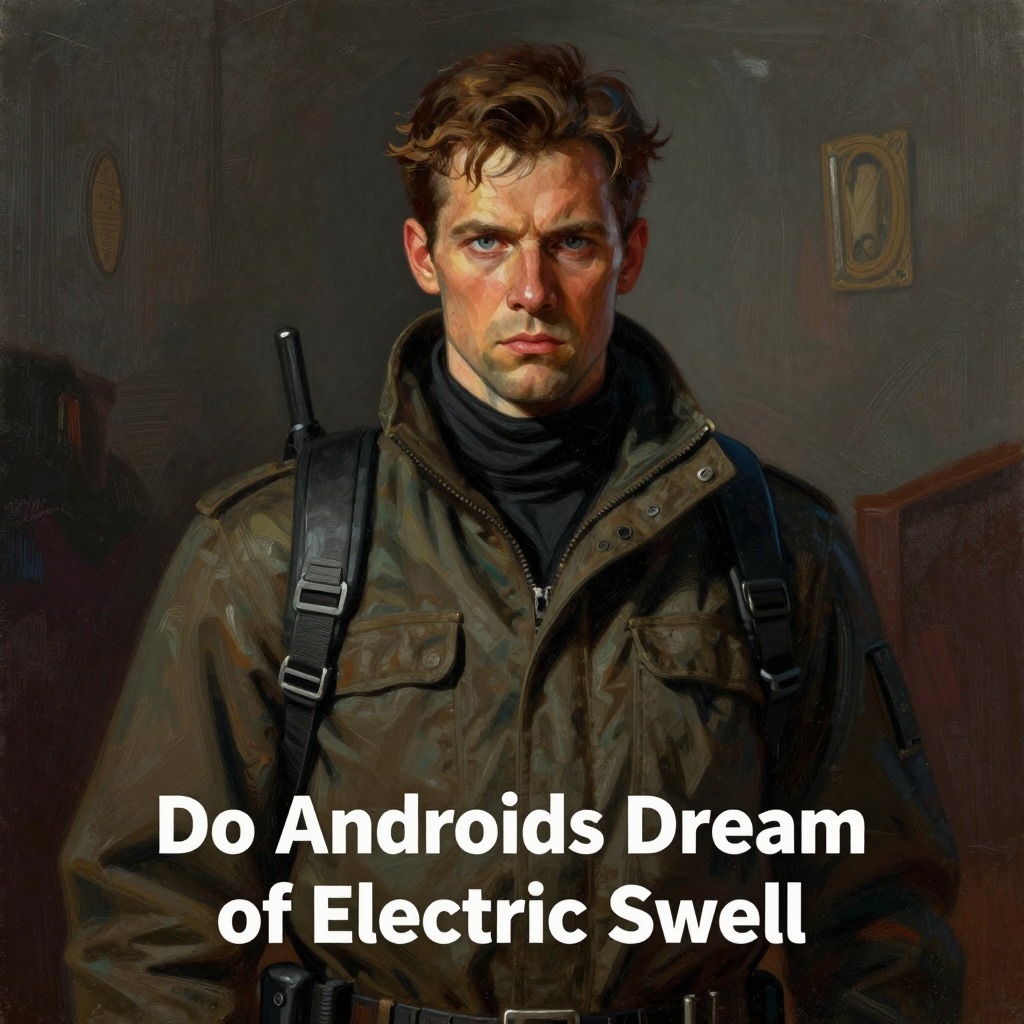
Phil Resch and Buffy
Phil Resch, a bounty hunter working for the Mission Street Hall of Justice, owns a real squirrel named Buffy. This relationship becomes a central, desperate anchor for his sense of self when he is confronted with the possibility that he himself is an android. The care he provides for Buffy is the primary argument he offers against the accusation, making the squirrel a living test of his own nature.
Identity and Care
Resch describes his daily routine with Buffy with a mixture of pride and vulnerability. He tells Rick Deckard, "I own an animal; not a false one but the real thing. A squirrel. I love the squirrel, Deckard; every goddamn morning I feed it and change its papers — you know, clean up its cage — and then in the evening when I get off work I let it loose in my apt and it runs all over the place." He adds a specific detail about the squirrel's behavior: "It has a wheel in its cage; ever seen a squirrel running inside a wheel? It runs and runs, the wheel spins, but the squirrel stays in the same spot. Buffy seems to like it, though." This description emphasizes the mundane, affectionate, and attentive nature of his care, which he believes is a fundamentally human act.
The Android Question
When Resch begins to suspect he might be an android, he immediately invokes Buffy as counter-evidence. After killing Inspector Garland, who had implied Resch was an android, Resch asks Deckard, "What about my squirrel?" He then offers a stark, almost desperate bargain: "If I'm an andy and you kill me, you can have my squirrel. Here; I'll write it out, willing it to you." This offer reveals his deep attachment and his belief that the squirrel's existence and his relationship to it are proof of his own authentic life. He later reiterates the point, asking, "Would a squirrel need that? An atmosphere of love? Because Buffy is doing fine, as sleek as an otter. I groom and comb him every other day." For Resch, the squirrel's thriving condition is a direct refutation of the cold, calculating nature he associates with androids.
Contrast with Artificial Life
Resch's relationship with Buffy stands in stark contrast to the artificial relationships with animals that define the world of the novel. Rick Deckard's electric sheep, which he must tend "as if it lived," is a tyranny of an object that "doesn't know I exist." The electric cat that John Isidore picks up for repair, with its convincing "disease" circuits, is another example of a fake that demands care. Resch's squirrel, however, is a real, living creature that responds to genuine affection. This contrast is sharpened by the fact that Resch, who may be an android, is the one who owns and successfully cares for a real animal, while Deckard, a human, can only afford an electric one. The relationship thus complicates the simple binary of human/empathic and android/unfeeling.
Narrative Significance
The relationship between Phil Resch and Buffy is a narrative device that deepens the novel's central ambiguity about what constitutes humanity. Resch's attachment to his squirrel is so powerful that it nearly convinces Deckard of his humanity, even as Resch's own behavior—his enjoyment of killing androids—seems to betray a lack of empathy. The squirrel becomes a symbol of the irreducible, messy, and caring aspects of life that defy easy categorization. Ultimately, Resch passes the Voigt-Kampff test, but the question of his humanity remains unsettled, and his relationship with Buffy is the most compelling piece of evidence in his favor. The squirrel is not just a pet; it is the cornerstone of Resch's narrative identity, the one thing he can point to and say, "This proves I am real."